

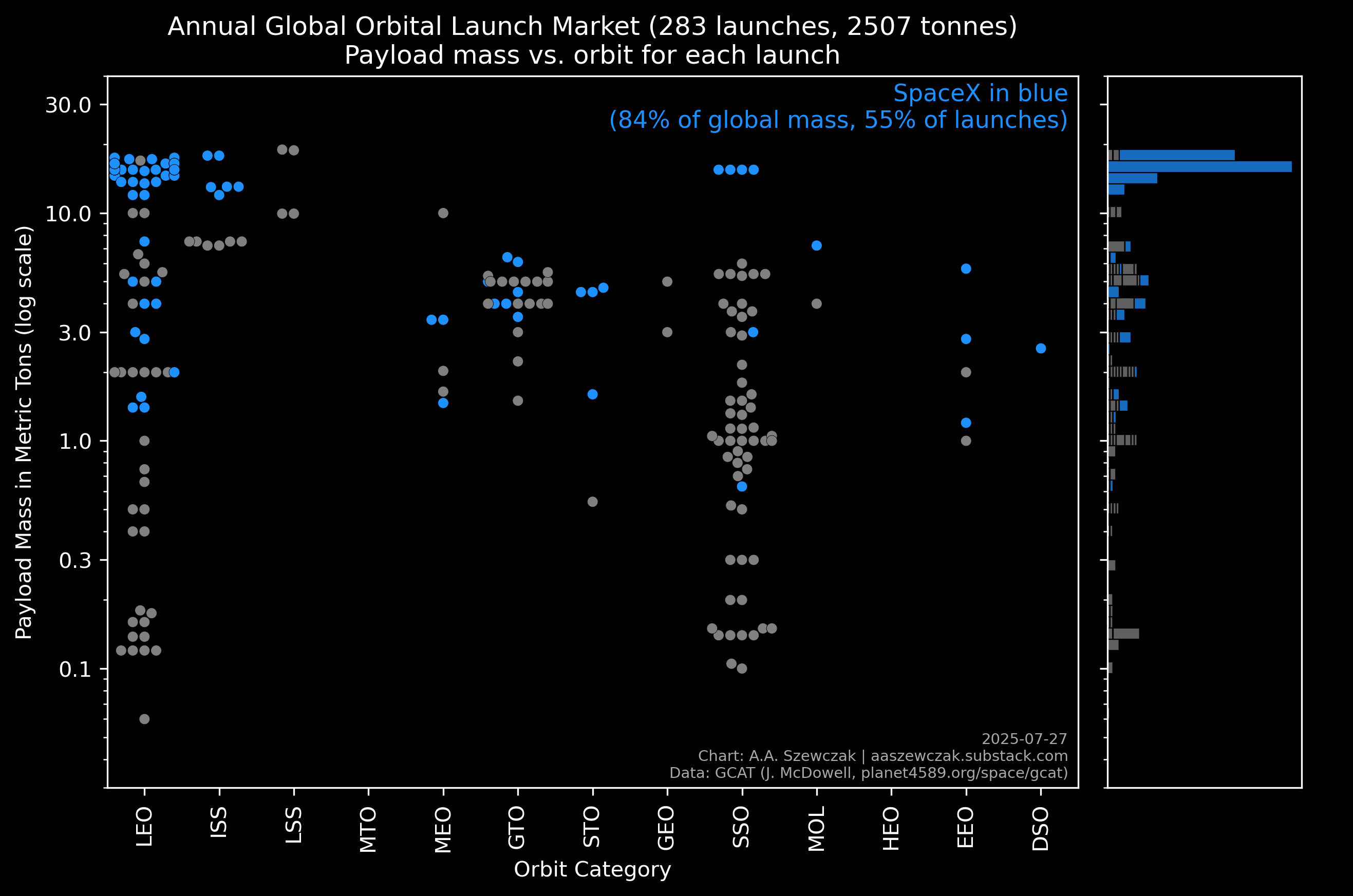
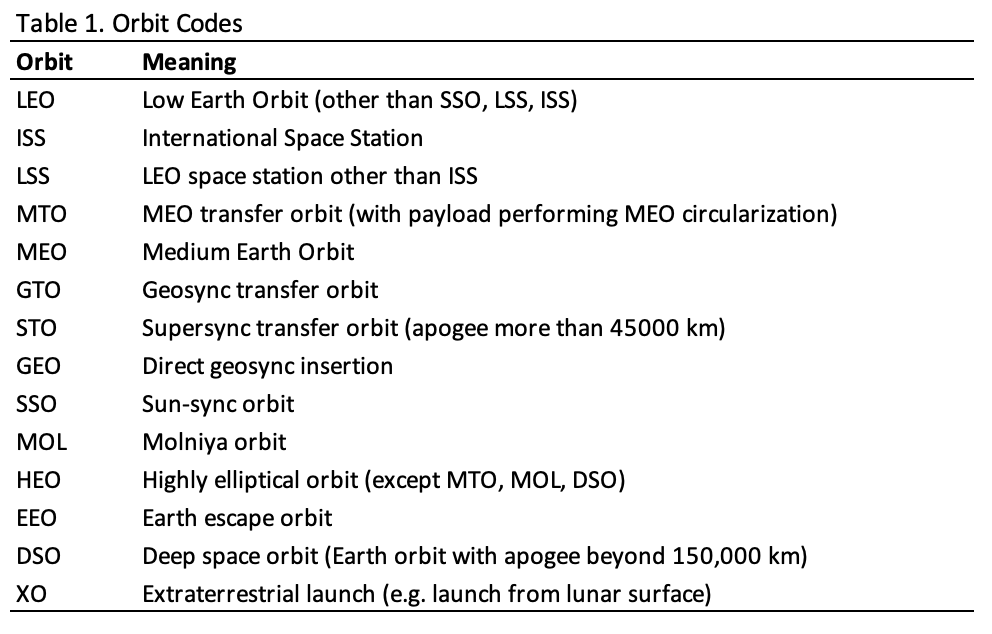
The chart above maps the global annual satellite and deep space launch market by plotting the distribution of payload mass (note the log scale!) vs. orbit type for 283 launches during the past twelve months. The bar chart on the right side is a histogram of the launch counts across all orbits. SpaceX alone (colored in blue) has reached an 84% share of annual mass flow to orbit, dominating the industry in LEO, SSO, STO, MOL, EEO, and DSO. In contrast MEO, GTO and GEO are more competitive.
Below is the same launch market information, color-coded by country:
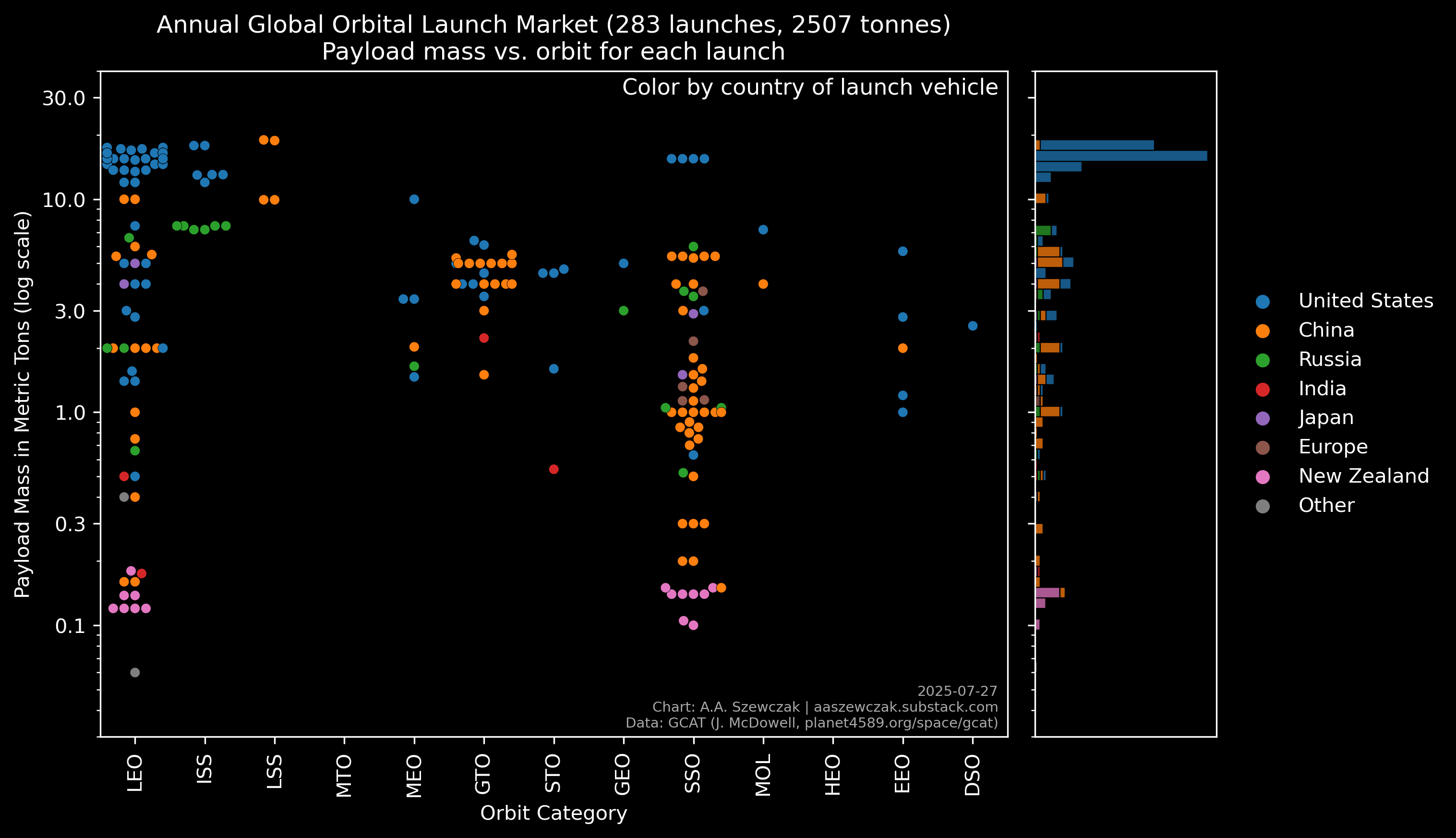
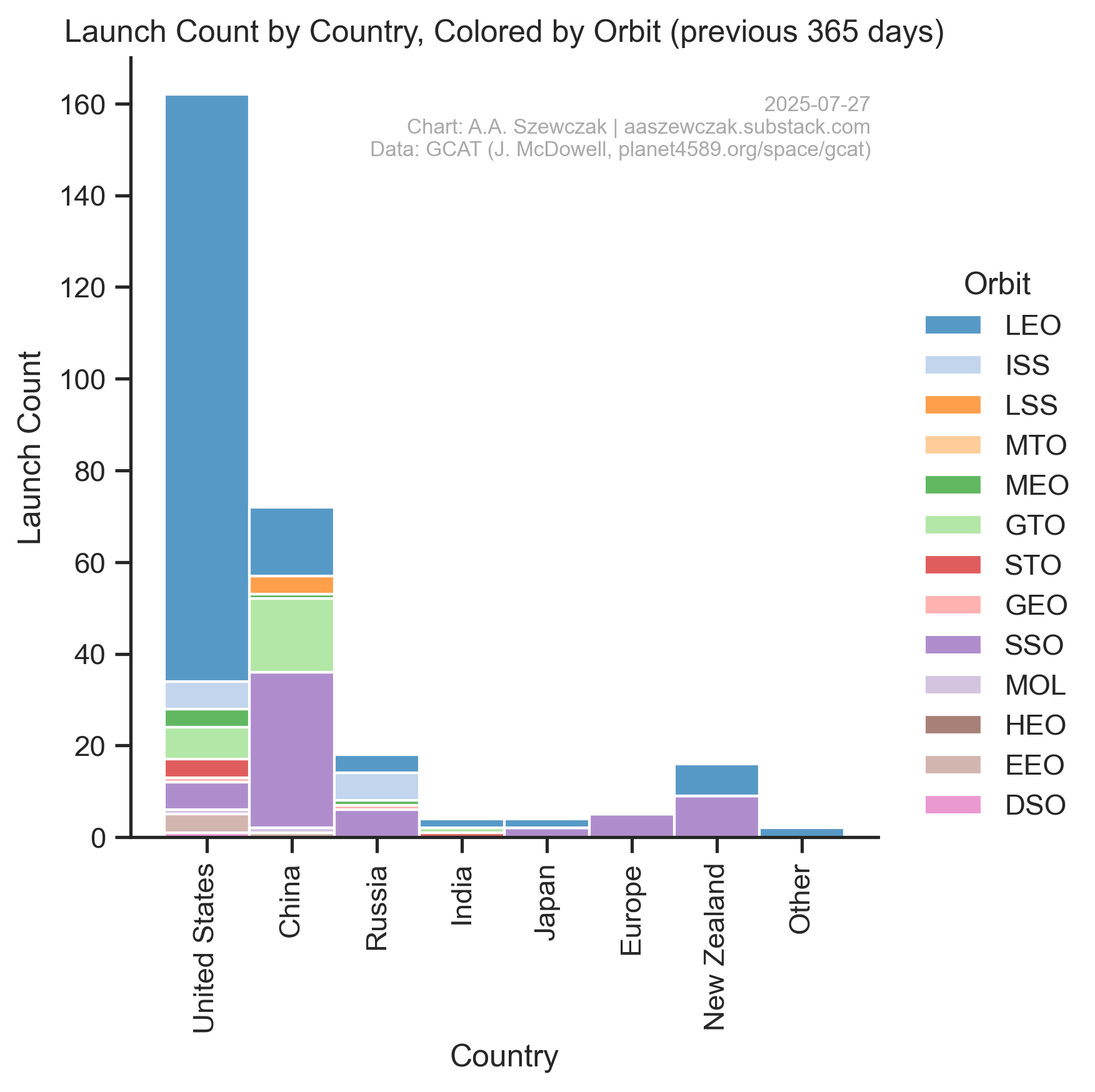
United States and Chinese launches predominate, with Russia and “New Zealand” (a.k.a. Rocket Lab) being the third and fourth most active launch countries. SpaceX Falcon 9 is delivering multi-satellite payloads in the range of 12-18 metric tons total mass. China has been focused on GTO and GEO destinations with payloads ranging between a few hundred kilograms and 6 metric tons, delivered with a variety of different launch platforms.
Here’s another look at the launch count by country, colored by orbit:
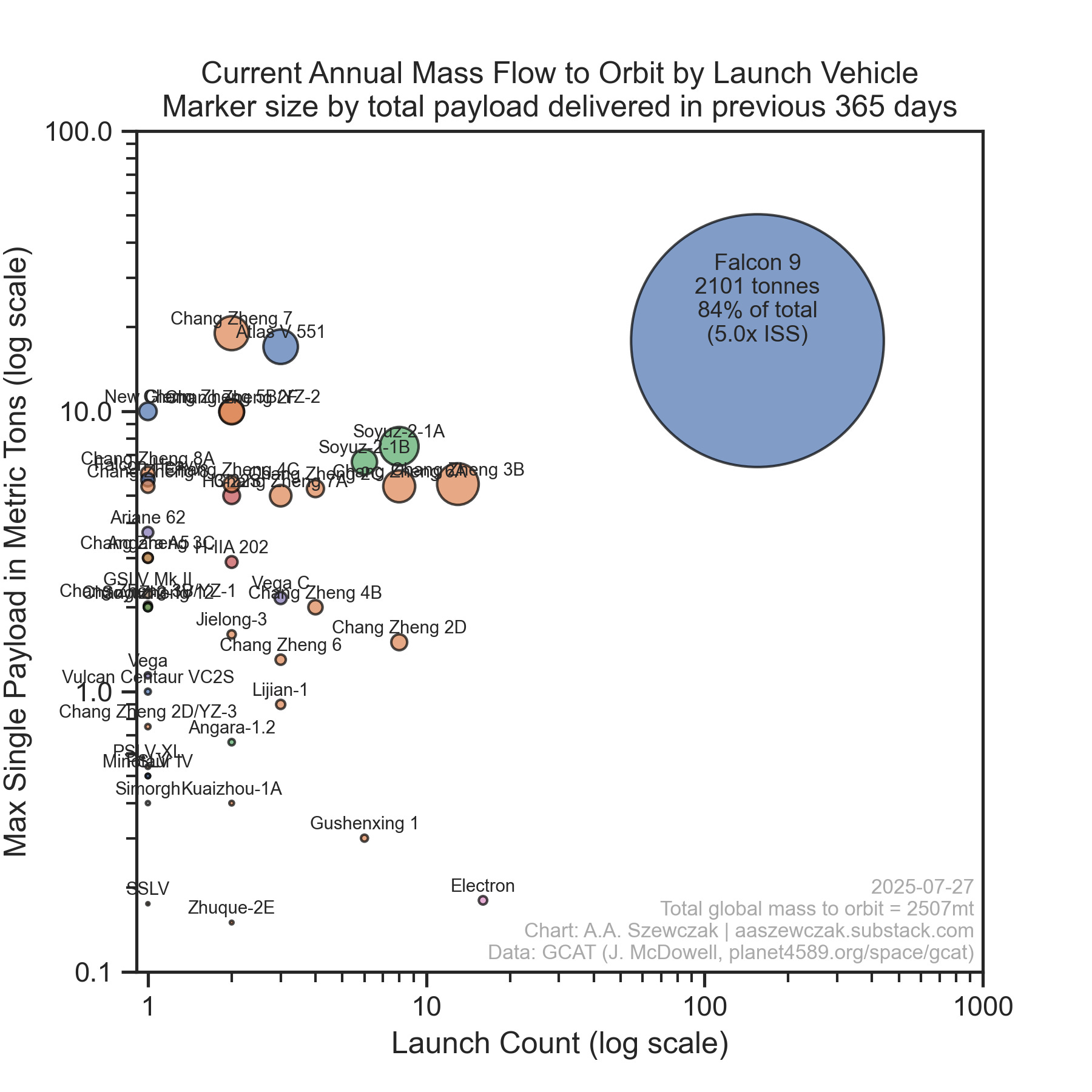
And this is the current trailing twelve month mass to orbit plotted for individual launch vehicles, color-coded by country. Note that Falcon 9 has reached the equivalent of launching five ISS space stations per year!
What comes next
Compared to a decade ago, the launch market has been transformed — from delivering relatively small numbers of high cost payloads to the ISS or geosynchronous orbits, to delivering vastly higher numbers of satellites into a variety of orbits. This has been entirely driven by the availability of the reusable lower cost Falcon 9 and the positive demand loop created by the low orbit Starlink constellation.
Blue Origin and China are the closest competitors to SpaceX and are actively pursuing their own mega constellations and developing new launch vehicles. However, SpaceX’s Falcon 9 cadence is continuing to accelerate with a learning rate of ~57% increase in launch rate for every doubling of total launches. It will be a long while before other launchers can catch up. But that will be a topic for another post.